
William S. Key Closure History
The Oklahoma Department of Corrections announced in 2021 that William S. Key Correctional Center in Fort Supply would close because continued repair and operating costs were untenable. It was a minimum-security ODOC prison. The announcement said approximately 1,000 prisoners would be moved to other minimum-security institutions. A later Board of Corrections packet reported that relocation was complete by November 5, 2021.
The official ODOC closure announcement is the source for the closure and transfer plan:
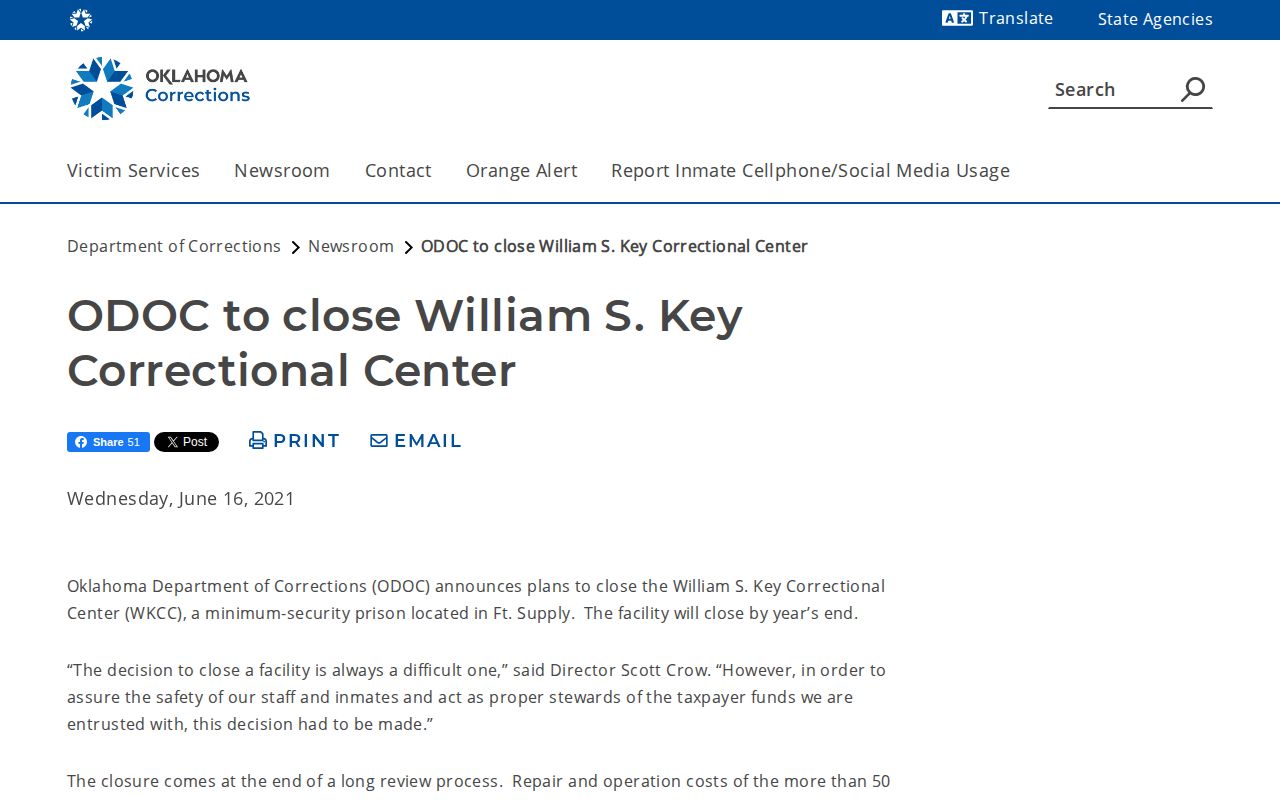
The image establishes that the site closed. It does not list individual transfer destinations or later release dates. Old articles, maps, and directories that still name William S. Key should be read as historical references.
Key Transfers Were Not Releases
The closure ended custody at one prison, but it did not end each prisoner's sentence. ODOC described relocation to other minimum-security facilities. Movement from Key to another ODOC institution was a transfer within the state corrections system. A prisoner may later have paroled, discharged, moved again, or entered community supervision, but those later events need their own dates and records.
This distinction matters when an old source says a person was “at William S. Key.” The safe sequence is William S. Key custody, ODOC transfer, later institution or supervision, then any discharge. Do not skip the transfer step or assign the closing date as an individual's release date. The closure announcement provides system context, not a personal movement chronology.
| Event | What it means | Best source |
|---|---|---|
| Key closure transfer | State custody continued elsewhere | ODOC movement record |
| Parole decision | Conditional release action, subject to later processing | PPB result plus ODOC status |
| ODOC discharge | State custody or supervision ended as recorded | ODOC discharge or Closed Records file |
| Transfer to detainer | Another authority may retain custody | Receiving agency record |
Note: Closing a prison is not a mass release, and removal from that facility's population does not establish community discharge.
Find William S. Key Prisoners
Search the official ODOC Offender Lookup by DOC number whenever possible. The verified form offers DOC Number, First Name, Last Name, Date of Birth, an option to include alias data, and an option for similar-sounding names. DOC number is the strongest key because names can collide. Match the result with date of birth, county, case, offense, and custody clues before treating it as the same person.
The portal warns that its data is abbreviated and that a changed data source has caused unanticipated issues. A public result is therefore a lead, not the full William S. Key movement file. The public FAQ also says an inmate's release date can be confidential and tentative. Do not claim that every public detail page displays a final discharge field or exact future date.
- Gather the full name, birth date, DOC number, Woodward or other case number, and known Key custody dates.
- Search DOC number first, then exact name and birth date; use alias or phonetic options with care.
- Compare identifiers and note the current institution, supervision clue, or other displayed status.
- Request the movement chronology and later discharge record when the public result does not resolve the path.
The statewide search is correct because Key belonged to ODOC. The county jail's register does not own the state prison movement or discharge record unless there was a separate Woodward County Jail booking.
William S. Key Discharge Records
ODOC policy OP-060212 describes a long-lived offender record. The field file remains active while custody or supervision continues. On a probation or parole movement, the record follows the proper P&P region. After termination, disposition information is finalized, the file is digitized into Closed Records, and inactive records are kept indefinitely. That life cycle makes Closed Records the key route for a former Key prisoner whose public result is thin.
Call Closed Records at 405-425-2691. ODOC Legal Services lists osordischarges@doc.ok.gov for discharge-only questions and osor@doc.ok.gov for offender-record or registry inquiries. A useful request includes DOC number, full legal name, date of birth, Key custody range, county and case numbers, and exact documents sought. Ask for reception and movement chronology, Key transfer information, later institutions, discharge type and date, and supervision closing status.
The official Authorization for Release of Incarceration/Supervision Records may help when protected details require the subject's consent. It asks for offender identity, recipient details, purpose, scope, and signature. Do not state that this authorization is required for every nonconfidential public record. Ask ODOC to identify confidential portions and release reasonably available public material.
- Movement chronology
- The dated history of transfers among ODOC locations and supervision offices.
- Parole
- Conditional release from a prison sentence while the sentence remains in force.
- Discharge
- The recorded completion or termination of ODOC custody or supervision.
- Closed Records
- ODOC's repository for inactive digitized offender records after custody and supervision end.
Key Parole Release Evidence
The Oklahoma Pardon and Parole Board publishes monthly dockets and official results. A docket can show an expected hearing, parole eligibility date, projected release date, sentence details, and case information. A result can show “Parole Denied by Board,” “Parole To Street,” “Parole To Detainer or Void,” or a pass to later consideration. Read the action literally.
“Parole To Street” is favorable, but it is not proof that the gate opened that day. Placement, programming, certificates, detainer review, and facility processing may remain. “Parole To Detainer or Void” specifically indicates that another custody process can control. Confirm actual departure through ODOC, the institution holding the person after Key, and a subsequent movement or discharge record.
A projected release date, abbreviated PRD, is also an estimate. Earned-credit class, misconduct, achievement credits, sentence structure, court changes, and detainers can move it. The PPB result supplies evidence about board action; the ODOC record supplies the later custody event. Neither should be replaced with the date William S. Key closed.
William S. Key Record Contacts
There is no active William S. Key release desk to call. The correct contact is ODOC, with the unit chosen by the question. Public portal questions begin with Offender Lookup. Historical custody and discharge belong with Legal Services or Closed Records. Active community supervision may belong with the assigned probation and parole office.
Oklahoma Department of Corrections Closed RecordsStatewide historical ODOC records
Telephone: 405-425-2691
Discharge email: osordischarges@doc.ok.gov
Offender records: osor@doc.ok.gov Woodward ODOC Probation and Parole
1104 Hillcrest
Woodward, OK 73801
Telephone: 580-254-1539
Serves Woodward and six neighboring counties
The Woodward P&P office can matter even when the prison sentence began elsewhere. Office assignment can follow a person's residence and regional supervision plan. An office assignment may help confirm active supervision, but it does not prove the earlier physical release date from the later prison.
Confirm a Key Prison Release
A complete confirmation identifies the last actual ODOC institution, not just William S. Key. Start with the movement chronology to learn where the person went during the closure transfers. Then identify whether the later record shows continued imprisonment, parole, another transfer, or discharge. If a detainer appears, check the named receiving authority.
Use PPB records for parole action and ODOC for physical and supervisory status. OK VINE can provide a participating-agency custody-change notice, but it is not a permanent sentence archive. A missed alert or no-match should lead back to ODOC records. Court dockets can explain sentence or later revocation events, though the facility record controls operational movement.
The Woodward County released-inmate record path helps classify a county, state, or federal custodian. For this facility, the answer is firmly state-level. William S. Key's closed status is the starting fact, not the end of the person's custody story.
If the movement record and public lookup appear to disagree, ask ODOC which record is current and whether the public portal omitted an inactive or historical field. Include the exact screen date and DOC number. A correction request should identify the disputed institution, movement date, or discharge label and attach the relevant court or agency document. Do not edit the timeline by assumption. William S. Key may properly remain in history even when a later institution supplied the actual release, and the last valid ODOC event should control the present conclusion.