
Oklahoma DOC Release Scope
ODOC holds people serving Oklahoma state sentences and supervises parolees and many probationers. Its record does not replace the Woodward County Jail register for a short local booking that never became an ODOC case. Conversely, the county jail cannot provide the later state-prison discharge record after a transfer to ODOC. The last actual custodian determines the first lookup.
A state record can show several different stages. Imprisonment means the person remains in an ODOC institution or related placement. Parole is conditional release from a prison sentence. Probation can arise from a suspended or deferred court sentence and does not always follow prison. Discharge means ODOC custody or supervision ended as recorded. A transfer between prisons changes location without releasing the person.
| Last custody | First source | Confirmation |
|---|---|---|
| Woodward County Jail only | Jail phone and discharge register | Woodward court file |
| Oklahoma state prison | ODOC Offender Lookup | Movement or discharge record |
| Parole or ODOC probation | ODOC lookup and P&P office | Order, certificate, or closing record |
| Federal or immigration custody | BOP, ICE, or USMS route | Federal record or receiving agency |
The split avoids a common error. A person disappearing from Woodward County Jail may have entered ODOC rather than the community. A state prisoner shown outside an institution may still be on supervision.
Search Oklahoma DOC Releases
The official ODOC Offender Lookup offers DOC Number, First Name, Last Name, Date of Birth, “Include alias data in search,” and “Include similar sounding names.” Search by DOC number first. If that number is unknown, use exact name and birth date. Treat aliases and phonetic results as possibilities until name, DOB, DOC number, county, case, offense, and custody clues agree.
The official screen includes a system disclaimer and search form:
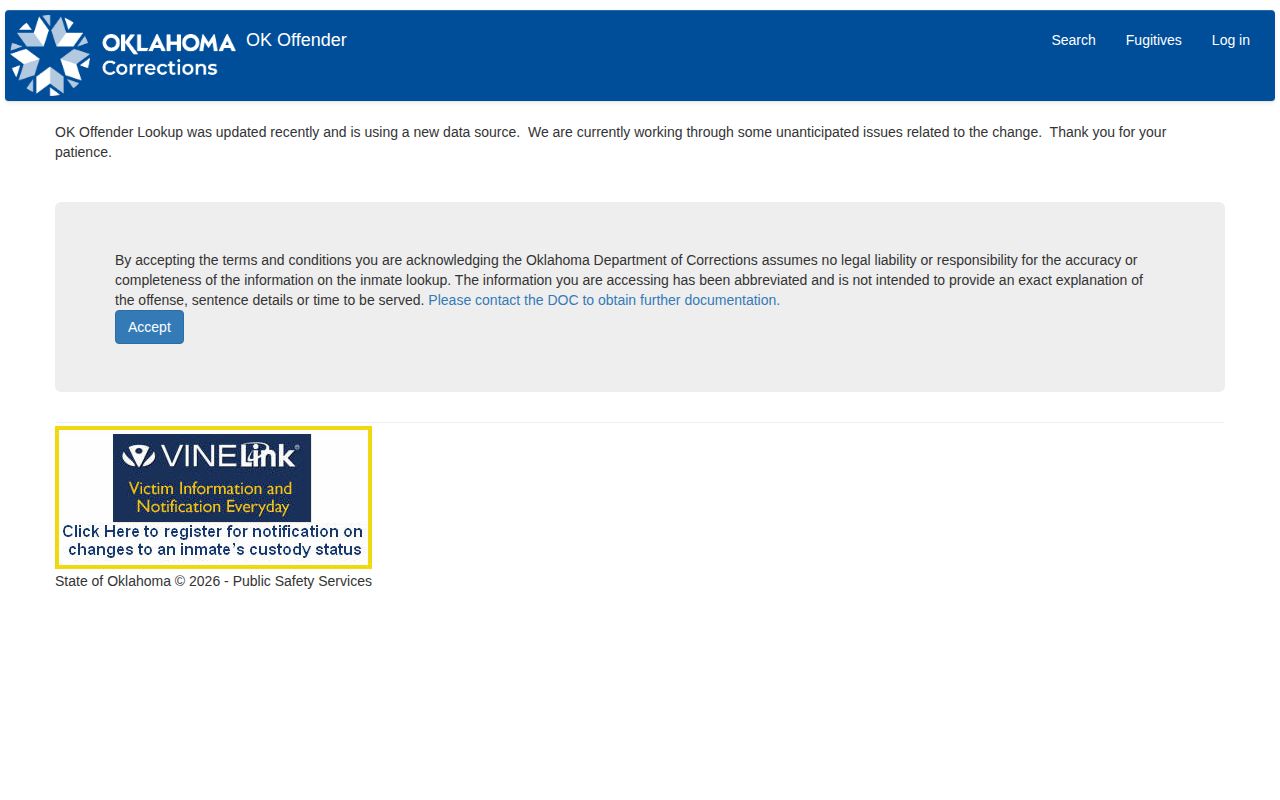
The warning matters. ODOC describes its public data as abbreviated and says a new data source has created unanticipated issues. A name match alone is not enough, and a no-match is not a final discharge record.
- Gather the full name, date of birth, DOC number, county case number, and approximate custody dates.
- Accept the portal notice and search by DOC number, or use name and DOB when necessary.
- Open the closest match and compare all stable identifiers before relying on the result.
- Use the DOC number in PPB records and in a request for movement, discharge, or supervision history.
Oklahoma DOC Release Dates
ODOC's public FAQ says an inmate's release date is confidential absent an appropriate judicial or law-enforcement-type need. It describes the date provided to the inmate as tentative because earned-credit level, misconduct, and achievement credits can change it. The public offender detail therefore should not be promised to show an exact projected date or a standardized “Discharged” field in every case.
Public Pardon and Parole Board dockets and results use “PRD” for projected release date and “PE DATE” for parole eligibility. These fields are not actual discharge dates. A PRD estimates sentence release after credits and administration. PE DATE marks when parole consideration may become available under applicable rules. A favorable parole action can still be followed by conditions, placement, detainer review, and prison processing.
After the event, request a movement or discharge record. Ask for the last institution, actual movement date, discharge type and date, any parole or supervision movement, and final closing status. A record created after departure answers a different question than a forecast made before it.
- PRD
- Projected release date, an estimate that can change.
- PE DATE
- Parole eligibility date, not a promised release.
- Detainer
- A hold or notice from another authority that can affect where the person goes.
- Discharge
- ODOC's recorded end of custody or supervision.
Oklahoma DOC Closed Records
ODOC policy OP-060212 explains why the live search is not the only route. An offender field record remains active through custody or supervision. On a parole or probation movement, the file goes to the proper P&P region. After termination, disposition information is finalized, the file is digitized into Closed Records, and inactive records are maintained indefinitely.
Closed Records can be reached at 405-425-2691. ODOC Legal Services publishes osordischarges@doc.ok.gov for discharge-only requests and osor@doc.ok.gov for offender-record and registry matters. Identify the person with DOC number, full name, DOB, custody range, Woodward or other county case numbers, and precise documents sought. A request can ask for reception and movement chronology, discharge date and type, supervision closing status, and a releasable offender photograph.
ODOC Closed Records and Legal ServicesStatewide Oklahoma records
Closed Records: 405-425-2691
Discharges: osordischarges@doc.ok.gov
Offender records: osor@doc.ok.gov
Legal Services: 405-425-7601
The Authorization for Release of Incarceration/Supervision Records can support access to protected detail with a valid signature. It is not a blanket requirement for every public record. Ask ODOC to identify confidential portions and supply segregable public information.
William S. Key Closure Records
William S. Key Correctional Center gives Woodward County a distinct stale-directory problem. ODOC closed the Fort Supply minimum-security prison in 2021 and transferred approximately 1,000 prisoners to other minimum-security institutions. A later corrections packet reported that relocation had been completed. Closure did not discharge the population.
Trace a former Key prisoner by requesting the ODOC movement chronology. It should identify the later institution or supervision movement, subject to lawful access limits. The subsequent release belongs to the later ODOC custodian and statewide offender file. The Key closure date should never be substituted for a personal release date.
Old search results may still list the prison as active or attach a person's name to Fort Supply. Verify the publication date, then use the current ODOC portal and Closed Records. The William S. Key record page separates the historic closure, mass transfer, and each former prisoner's later release path.
Note: A transfer from a closed state prison continues ODOC custody and is not a release to the community.
Oklahoma DOC Parole Confirmation
The Oklahoma Pardon and Parole Board decides parole matters, while ODOC administers custody and supervision. Monthly dockets are prospective. Official results report the board action after processing. Neither document alone proves the date of physical departure. Votes become final after the meeting adjourns and are validated and posted.
Outcome language should be read without embellishment. “Parole Denied by Board” means no grant from that action. “Parole To Street” is favorable but may carry prerequisites. “Parole To Detainer or Void” points to another custody process. “Passed” means later consideration, not release. Revocation results may show that someone previously in the community returned to custody or faced sentence consequences.
After a favorable action, check ODOC, the actual institution, OK VINE, and any detainer. For active supervision connected to Woodward, the ODOC P&P office at 1104 Hillcrest can be reached at 580-254-1539. It serves Woodward plus Alfalfa, Dewey, Ellis, Harper, Roger Mills, and Woods counties. Office assignment confirms a supervision relationship, not the former prison's gate time.
Confirm Oklahoma DOC Discharge
Build the proof chain around dates and systems. First identify the state prisoner by DOC number. Next establish the last institution or supervision office. Then obtain a post-event movement or discharge record. Add the PPB result when parole was involved and the court file when a judgment, sentence change, or revocation matters.
OK VINE can report custody changes from participating sources and accept release-alert registrations. It is useful prospectively, but it does not replace the Board's separate parole-notification process or ODOC's durable record. VINE can also lose continuity during some mental-health transfers. A released result means the supplying agency reported a change, not that all possible custody ended.
The Woodward County search and release-record hub starts with the last known facility. For ODOC, rely on statewide sources even when the conviction, residence, supervision office, or former prison has a Woodward connection. That keeps a state discharge distinct from a county jail release and a federal custody event.
When a completed ODOC file needs correction, identify the DOC number, disputed movement or discharge field, and the supporting judgment, sentence, or agency record. Direct a sentence-computation issue to the records officer or Legal Services rather than VINE, because VINE receives custody data but does not originate the sentence record. For a court discrepancy, work with the court clerk. Keeping the correction with the office that created the field gives ODOC Closed Records a clear basis for an amendment or explanatory response.